
Unlocking a US$3 trillion Market

Luke Sanders is Co-Founder and Managing Director of Foxglove Defence, an Australian investment platform that sources, validates and accelerates early-stage defence and dual-use technologies across allied markets.
This article is for Australian Wholesale and Professional investors only. Nothing in this article constitutes an offer, invitation or recommendation to acquire or dispose of any financial product.
Investors have traditionally viewed defence as a difficult asset class for venture capital. Complex procurement systems, long acquisition cycles, sovereign restrictions and highly regulated markets create barriers that appear fundamentally at odds with the speed and scalability required to generate venture-style returns.
As a result, many Australian investors have avoided the asset class altogether. Yet, there is nobetter time to challenge these assumptions.
Global military expenditure reached almost US$3 trillion in 2025, following more than 40% real growth over the past decade.1 Importantly for investors, this structural shift is accelerating the development of new technologies, changing procurement models and creating defence companies capable of generating billions of dollars in enterprise value within traditional venture fund horizons.
The evidence is difficult to ignore and its time to challenge those assumptions.
After building careers across national security and venture capital, we see an extraordinary investment opportunity. But capturing it requires investors to look beyond a single geography, technology or segment of the defence market. Notwithstanding the extraordinary acceleration in expenditure, there are three areas we believe investors should focus on to take advantage of this structural change.
Value is emerging unevenly
The global defence market is not one homogenous US$3 trillion opportunity.
Different regions are responding to different strategic problems, supported by different industrial bases and national security priorities. The result is a series of increasingly distinct defence innovation ecosystems.
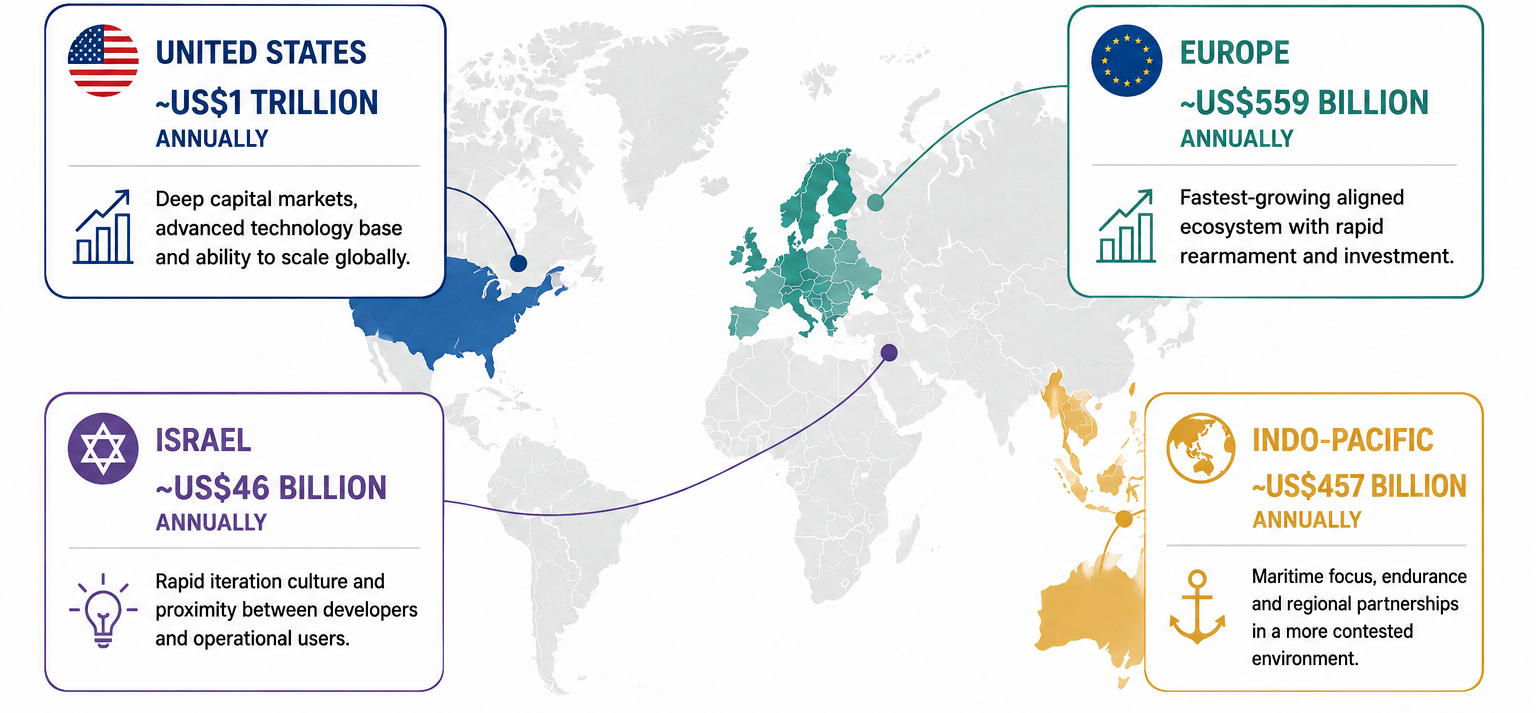
Europe is the fastest-growing aligned defence ecosystem at scale, with expenditure across Central and Western Europe increasing approximately 81% in real terms over the past decade. European NATO members alone spent US$559 billion in 2025, demonstrating both the speed and scale of the region's rearmament. 2
Across selected Indo-Pacific markets relevant to Australia’s national security interest and regional partnerships , expenditure has increased approximately 42%, driven by a very different strategic environment with greater emphasis on maritime security, endurance and regional partnerships3. The Middle East represents another significant defence ecosystem, with Israel and Gulf states combining high levels of defence expenditure with rapid operational iteration and close connections between technology developers and users.
Meanwhile, North America remains the dominant market at approximately US$1 trillion annually, combining enormous defence budgets with deep venture capital markets, sophisticated technology companies and an unparalleled ability to scale.
Importantly, these ecosystems are not isolated, but increasingly interconnected.
While sovereignty is often a focus of discussion in defence markets, it is only part of the story. More often, a technology may be conceived in one country, operationally validated in another, manufactured somewhere else and ultimately adopted across multiple allied militaries.
Investors anchored to a single geography risk missing both where innovation originates and where it ultimately scales. The opportunity is understanding what each ecosystem does particularly well, how quickly it can move, and where those capabilities can create value elsewhere.
Follow the allocation
The second shift is where capital and defence expenditure are flowing.
Historically, defence value creation was heavily concentrated around major platforms, large procurement programs and incumbent contractors. Those platforms remain critical, but a new generation of defence technology companies is demonstrating that significant enterprise value can be created much faster.
The comparison is striking.
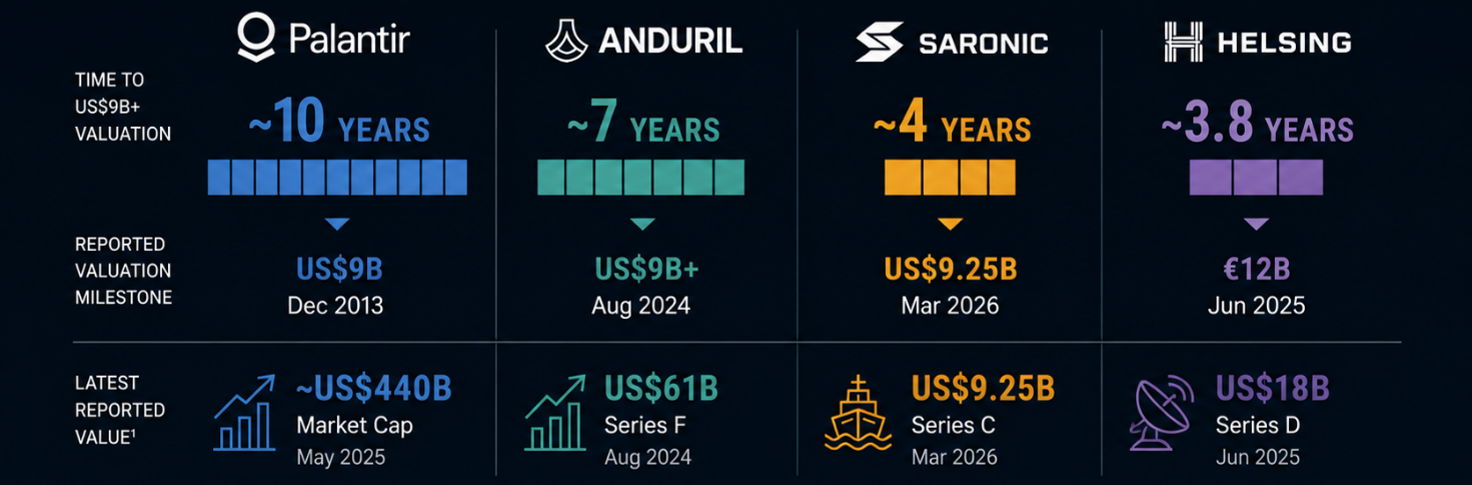
Palantir took many years to achieve a reported valuation above US$9 billion. Anduril compressed that considerably. More recently, Saronic achieved a US$9.25 billion valuation around four years after being founded, while European defence company Helsing exceeded the same threshold in less than four years. 4
This is an important development for venture investors. Defence technology is increasingly capable of generating multi-billion-dollar enterprise value within conventional fund horizons.
But investors should be equally cautious about concentrating around today's technology themes. Autonomous systems, AI, space, cyber and advanced weapons are developing at different speeds and solving different operational problems. Following the allocation means understanding where operational demand and capital are moving, rather than anchoring to any one technology.
There is also a pattern behind many of these successes.
First, they solve real operational problems. Technological sophistication alone is insufficient; successful capabilities need to materially improve operational outcomes.
Second, they are adopted. Recent conflicts have demonstrated the importance of moving quickly from experimentation to operational use. In 2025 alone, Russia launched approximately 55,000 Shahed-type one-way attack drones against Ukraine.5 Warfare is increasingly rewarding capabilities that can be produced, deployed, adapted and replaced at speed.
Finally, founders matter. Defence remains a highly relationship-driven market. Technical excellence must increasingly be combined with an ability to understand operators, navigate government, attract strategic capital and execute through complex regulatory and industrial environments.
For investors, the question is therefore shifting from simply what is the technology, to does it create meaningful advantage, can it be adopted quickly, and does the team have the credibility to scale it.
The next frontier
This leads to the third observation. The first wave of defence value was dominated by platforms - ships, aircraft, armoured vehicles and other major systems. The second has been characterised by increasingly intelligent and autonomous capabilities - drones, robotics, sensors, software and AI-enabled systems.
These remain important capabilities, but are not the next frontier for modern militaries. Our assessment is that a new wave of capability, with even shorter timeframes for accelerated value creation, is imminent and will focus on the adaptation and orchestration of the platforms and intelligent systems now being fielded.
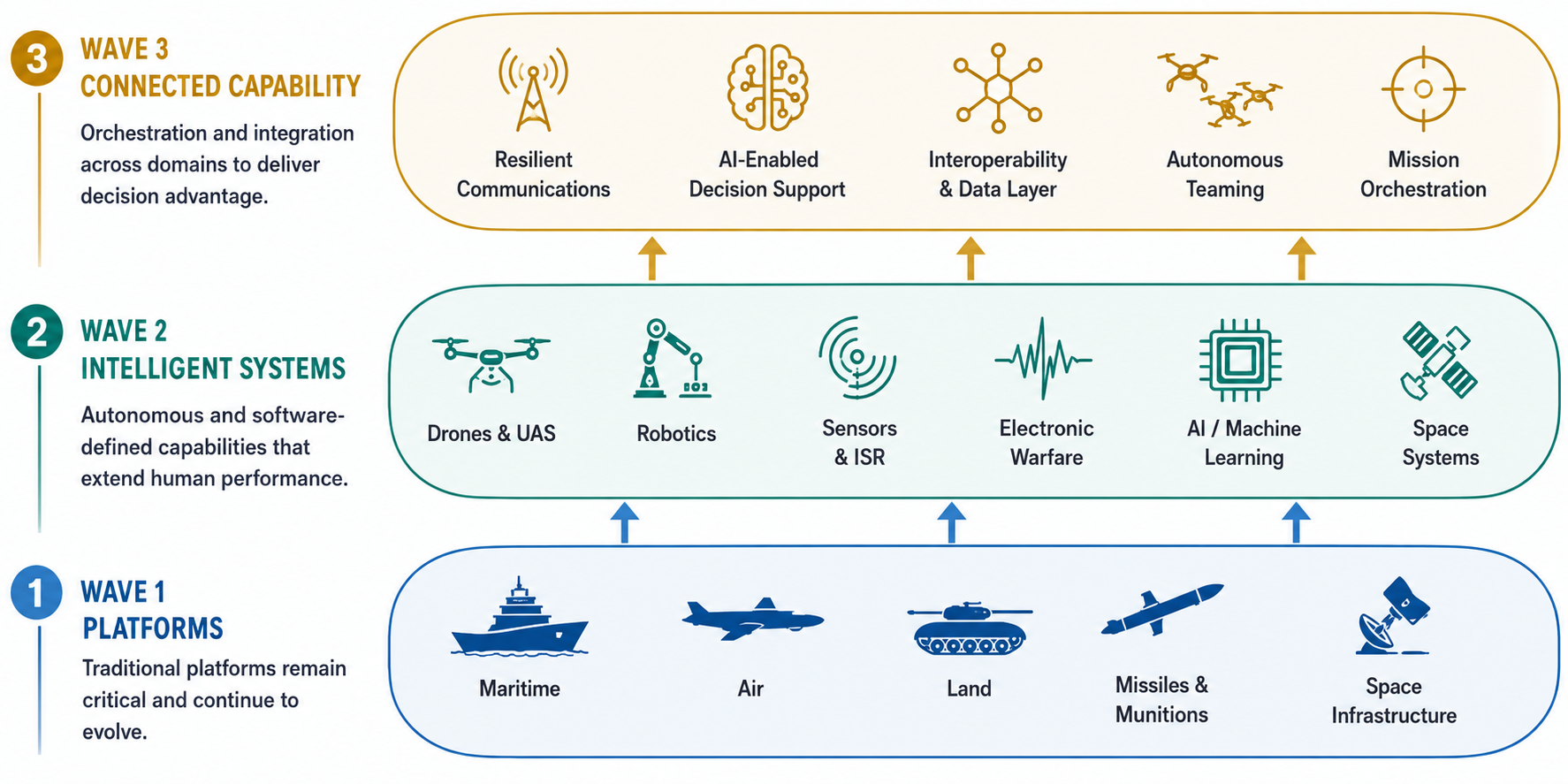
The next generation of operational demand is already emerging. Modern militaries increasingly have access to sophisticated platforms, autonomous systems, sensors and software. The next challenge is enabling these capabilities to sense, communicate, decide and act together across multiple domains, particularly in contested and degraded environments.
This creates opportunities around AI-enabled decision support, systems integration, autonomous teaming, resilient communications, and mission orchestration. The next generation of defence winners, therefore, is expected to be the companies that enable increasingly sophisticated capabilities to operate as a coherent whole.
Challenge the assumptions
For allocators and wholesale investors, the structural change in the defence sector represents a remarkable opportunity. The challenge is to contest the assumptions that have plagued defence investment for so long, and develop the understanding and access required to participate.
This requires looking across geographies rather than being anchored to a single market, following operational demand rather than concentrating on a single technology, and understanding how capabilities move between increasingly connected allied ecosystems.
But this understanding alone is insufficient, and barriers still remain. Deal flow is concentrated within trusted networks, while distinguishing what is technically impressive from what will create genuine operational advantage requires specialist knowledge. These barriers are real, but they also create an investment advantage for those able to navigate them.
ESG also remains a legitimate consideration, but the role of modern defence technology in strengthening deterrence, improving precision and reducing collateral damage should also challenge traditional assumptions about the sector.
As a result, the assumptions that have historically kept investors away from defence are now the same barriers that protect its value. For investors with the networks to access opportunities, the experience to validate them and the capability to accelerate their adoption, defence technology represents one of the most compelling frontier investment opportunities of this generation.
1. SIPRI Military Expenditure Database, 2016–2025.
2. Taken from Foxglove Defence analysis of the SIPRI Military Expenditure Database, constant 2024 US dollars, 2016–2025.
3. Including Australia, India, Japan, South Korea, Taiwan, Singapore, Philippines, Indonesia, Malaysia, Vietnam, Thailand, New Zealand and selected Pacific Island nations
4. Company announcements and publicly reported funding rounds; Anduril, Saronic, Helsing and Palantir valuation data, 2013–2026
5. Center for Strategic and International Studies (CSIS), The Geography of Coercion: Russian Missile and Drone Campaigns in Ukraine, July 2026.
Disclaimer
This article is intended for wholesale investors as defined under the Corporations Act 2001 (Cth) and is not intended for retail investors. The information provided herein is for general informational purposes only and does not constitute financial, investment, or professional advice.
The views expressed in this article are those of the author and do not necessarily reflect the official policy or position of Kings Gate Capital Partners. While every effort has been made to ensure the accuracy of the information, Kings Gate Capital Partners makes no representations or warranties, express or implied, as to the completeness, accuracy, reliability, suitability, or availability of the information contained in this article. Any reliance you place on such information is therefore strictly at your own risk.
Investing involves risk, including the potential loss of principal. Past performance is not indicative of future results. Before making any investment decision, you should seek independent financial, legal, and tax advice tailored to your specific circumstances.
This article may contain forward-looking statements that are subject to risks and uncertainties. Actual results may differ materially from those expressed or implied in such statements. Kings Gate Capital Partners disclaims any obligation to update or revise any forward-looking statements to reflect new information or future events.
For more detailed information contact us directly.

